

Introduction
DevOps engineers face mounting pressure to deliver faster, more reliable software amid complex cloud-native environments and rising security demands. AI tools address these challenges by automating CI/CD pipelines, predicting failures, optimizing resource allocation, and improving observability. In 2026, these tools will evolve with advanced generative AI, agentic workflows, and predictive analytics, enabling teams to shift from reactive firefighting to proactive engineering.
This blog explores the top 7 AI-powered tools essential for DevOps success, replacing Datadog with Middleware.io for lightweight observability and Dynatrace with Cast AI for Kubernetes optimization. Each section details key features, real-world use cases, and integration tips, drawing from current trends like AI-driven automation becoming standard practice. Mastering these will boost deployment speed by up to 50%, cut downtime, and optimize costs in multi-cloud setups.
1. GitHub Copilot
GitHub Copilot stands out as an AI coding assistant that generates code snippets, functions, and configurations in real-time based on context and natural language prompts. It supports dozens of languages, including Python, Go, Terraform, and Kubernetes manifests, integrating directly into IDEs like VS Code and JetBrains.
Key Features:
- Real-time code completion adapting to project style.
- Natural language to code translation for IaC scripts.
- Multi-language support for polyglot DevOps environments.
- Agentic capabilities via Agent HQ for multi-step tasks.
Use Cases and Real-World Scenarios:
A fintech firm uses Copilot to accelerate Terraform module creation during infrastructure provisioning. Developers describe “provision EKS cluster with auto-scaling,” and Copilot generates compliant HCL code, reducing scripting time from hours to minutes. In one scenario, a SaaS provider integrated it into GitHub Actions pipelines, cutting CI/CD config errors by 40% and speeding reviews.
Another example: During a microservices migration, engineers at an e-commerce company prompted Copilot for Helm charts, enabling rapid Kubernetes deployments across AWS and Azure, preventing rollback delays during peak traffic.
Integration and Pricing: Seamlessly works with GitHub Actions, Jenkins, and cloud CLI tools. Subscription starts at individual plans, scaling to enterprise with security filters.
2. AWS CodeGuru
AWS CodeGuru employs machine learning for automated code reviews and performance profiling, identifying bugs, security flaws, and inefficiencies in pull requests and live apps. Its Reviewer scans for concurrency issues and resource leaks, while Profiler pinpoints CPU hotspots with low overhead.
Key Features:
- Context-aware recommendations with fix examples.
- Security detection for vulnerabilities (note: Security feature ends support in late 2025).
- Integration with AWS CodePipeline and Git workflows.
- Scalable pricing per lines reviewed.
Use Cases and Real-World Scenarios:
A media streaming service integrated CodeGuru into their Jenkins pipelines to review Lambda functions pre-deployment. It flagged input validation gaps, averting potential breaches during a high-traffic event, saving weeks of manual audits.
In a real-world outage scenario, a logistics company profiled their Node.js app, discovering a memory leak in async handlers. Post-fix, latency dropped 30%, stabilizing Black Friday operations.
Why Essential in 2026: As codebases grow, CodeGuru’s ML evolves to handle serverless and containerized apps, aligning with AWS-native DevOps shifts.
3. Middleware.io
Middleware.io provides full-stack observability with AI-powered anomaly detection, unifying metrics, logs, traces, and events in a lightweight agent for real-time monitoring across clouds. OpsAI automates issue detection, root-cause analysis, and even generates pull requests for fixes, reducing MTTR dramatically.
Key Features:
- AI-driven alerts with zero false positives and auto-remediation.
- Unified dashboard for APM, infrastructure, RUM, and synthetics.
- Root-cause correlation and solution recommendations.
- Integrations with 200+ tools like Slack, PagerDuty.
Use Cases and Real-World Scenarios:
A DevOps team at a SaaS company used Middleware’s OpsAI to detect a Kubernetes pod crash from memory leaks during a traffic spike. It correlated logs/traces, suggested scaling fixes, and auto-restarted pods, cutting resolution from hours to minutes and preventing downtime.
In an e-commerce rollout, Middleware unified frontend RUM with backend traces, identifying a Java app bottleneck pre-peak season. AI-generated PRs fixed it, improving MTTD by 80% and ensuring seamless Cyber Monday performance.
Integration and Pricing: Supports Datadog agent migration, OpenTelemetry auto-instrumentation for Python/Node/Java; usage-based with free trial.
4. Snyk
Snyk focuses on developer-first security, scanning code, dependencies, containers, and IaC for vulnerabilities with ML-prioritized risk scores and auto-fix PRs. It embeds into pipelines for shift-left security.
Key Features:
- Continuous scanning across open-source, IaC (Terraform).
- Exploitability-based prioritization.
- Kubernetes and Docker runtime protection.
- Policy enforcement for compliance.
Use Cases and Real-World Scenarios:
A bank integrated Snyk with Jenkins to halt builds on vulnerable npm packages, fixing a Log4j-like issue pre-prod and passing audits seamlessly.
Financial services used container scanning in Kubernetes, rebuilding images after base vuln alerts, and thwarting a supply-chain attack during quarterly updates.
Why Essential in 2026: With DevSecOps mandates rising, Snyk’s AI Trust Platform ensures compliant, secure deployments at scale.
5. Harness
Harness automates continuous delivery with ML-driven verification, supporting canary/blue-green deploys and GitOps. It optimizes costs across multi-cloud via predictive scaling.
Key Features:
- AI verification for deployment health.
- Pipeline as code with policy gates.
- Multi-cloud cost dashboards.
- Slack/Jenkins integrations.
Use Cases and Real-World Scenarios:
A global retailer managed AWS/Azure deploys, using Harness to roll back 20% risky canaries automatically, maintaining zero-downtime during sales peaks.
E-commerce optimized cloud bills by spotting idle resources, reallocating savings to scale EC2 during traffic spikes without overprovisioning.
Integration and Pricing: Works with Terraform, Kubernetes; modular SaaS pricing.
6. Cast AI
Cast AI automates Kubernetes optimization across AWS, Azure, and GCP, using agents for 24/7 rightsizing, autoscaling, Spot Instance orchestration, and security enforcement. It delivers real-time cost visibility by cluster/namespace without tagging, cutting bills by 50–75%.
Key Features:
- Intelligent autoscaling with bin packing and workload rightsizing.
- GPU/LLM and database optimization.
- Misconfiguration detection and policy fixes.
- Multi-cloud support with no-downtime scaling.
Use Cases and Real-World Scenarios:
An e-commerce platform scaled Kubernetes during peak seasons with Cast AI’s autoscaling, dynamically shifting to Spot instances and rightsizing pods, slashing costs by 60% while handling 3x traffic without slowdowns.
A SaaS provider optimized ML workloads, auto-adjusting GPU resources based on queue depth and reclaiming idle capacity, reducing infra spend by 50% and boosting DevOps productivity by automating tuning tasks.
Integration and Pricing: Connects to EKS/GKE/AKS; pay-for-savings model with free monitoring.
7. Spacelift with Saturnhead AI
Spacelift orchestrates IaC workflows (Terraform, Pulumi) with Saturnhead AI for log analysis and Intent for natural-language provisioning, such as “spin up QA env.” It handles drift detection and policies.
Key Features:
- AI troubleshooting of failed runs.
- Stack dependencies and blueprints.
- Policy-as-code guardrails.
- Self-service IaC.
Use Cases and Real-World Scenarios:
A meat industry firm used Spacelift to IaC-ify its infrastructure, Saturnhead slashing failed run debug time by 5x, boosting dev velocity.
Teams provisioned demo stacks via Intent, inheriting policies, accelerating PoCs from days to minutes without ops bottlenecks.
Integration and Pricing: Terraform/K8s focus; free tier to enterprise.
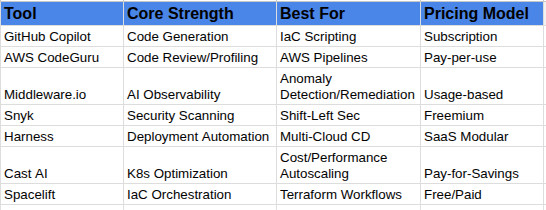
Comparison Table
Challenges and Best Practices
Adopting AI tools involves hurdles like integration complexity and skill gaps. Start small: Pilot one tool per pipeline phase (e.g., Copilot for code, Middleware.io for monitoring). Train teams on prompts and interpretations. Ensure data privacy via RBAC. In 2026, hybrid human-AI teams excel, with AI handling 70% routine tasks.
Future Outlook
By 2026, expect agentic AI to dominate, orchestrating end-to-end pipelines autonomously while humans focus on strategy. Trends like platform engineering amplify these tools’ impact, driving sustainable, value-focused DevOps.
For more such insights, connect with me on LinkedIn: Neel Shah!